Into God's Best for Your Life Part 4

Feeling Stuck?
An Ancient Text Offers a Surprising Way Forward
We all know the feeling of being at a fork in the road, but sometimes it’s more than that. It’s a feeling of being spiritually snowed-in, where every potential path seems iced over and impassable. Whether it’s a major family decision, a career pivot, or where to send your child to school, these moments can leave us feeling trapped and overwhelmed. It’s in these times of confinement that we often ask the same fundamental question: "God, which way do I go?"
When the way forward is unclear, it’s easy to feel like there are no good options. Yet a short, ancient passage from the book of Isaiah offers a powerful framework for navigating these moments of deep uncertainty. It suggests that the very places where we feel most lost are the intended settings for a brand-new beginning. This passage doesn't offer a simple map, but rather a reliable process for navigating uncertainty with faith.
1. The "Wilderness" is Where New Paths Are Made
The scripture from Isaiah presents a counter-intuitive idea: desolate places like a "wilderness" or "desert" are not just obstacles to be overcome but are the very settings where God promises to do a "new thing." These words were written to the people of Israel, but the context is what gives them their staggering power. This promise was recorded roughly 150 years before Israel would be taken into captivity. It wasn't a comfort for an impending difficult season; it was a foundational, long-term promise of future restoration, declared over a century before their darkest days would even begin.
The modern application of this is profound. Our personal "wilderness" moments—times of confusion, hardship, or deep uncertainty—are often the exact places where a new way forward can emerge. It’s a reminder that hope is not about avoiding difficulty, but about understanding that God’s most hopeful work happens right in the middle of it.
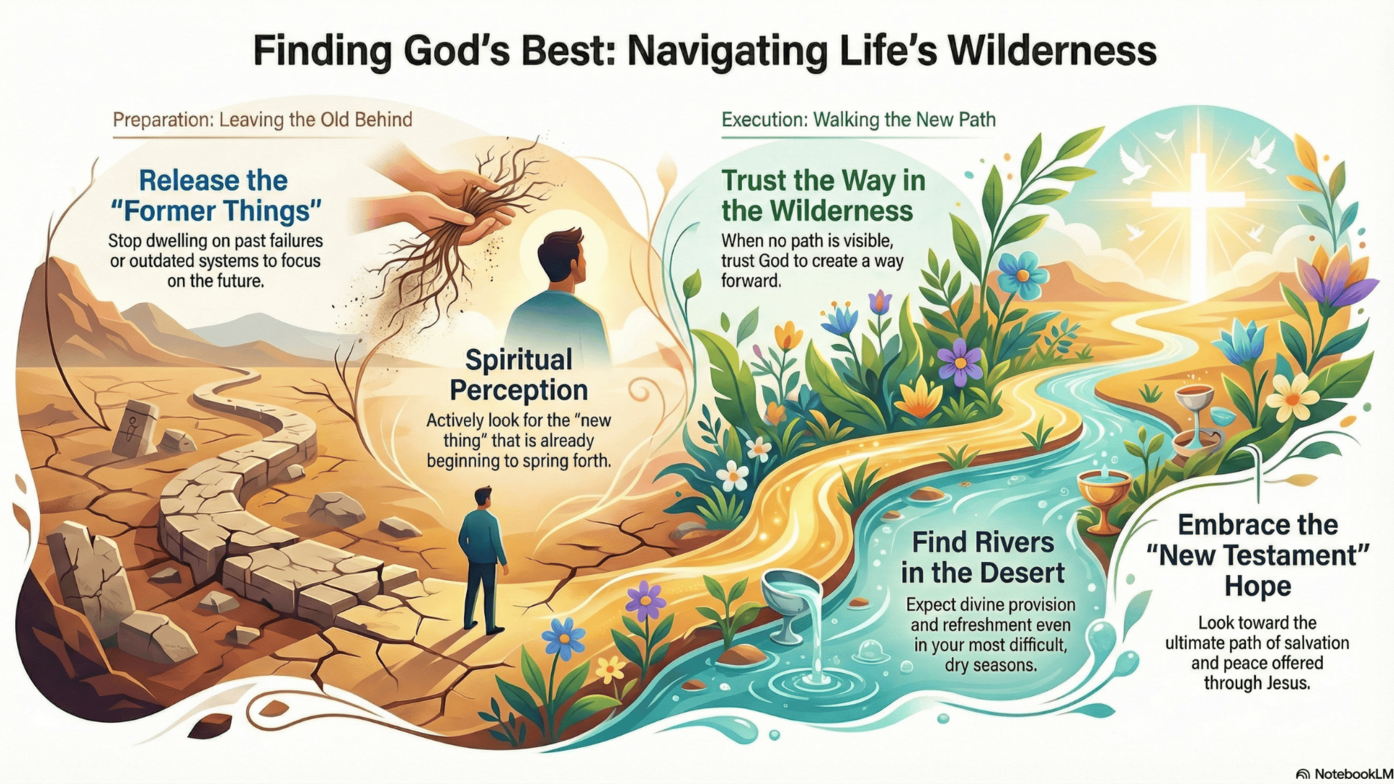
"Remember not the former things nor consider the things of old. Behold, I am doing a new thing now. It springs forth. Do you not perceive it? I will make a way in the wilderness and rivers in the desert." — Isaiah 43:18-19
2. "Forgetting the Past" Doesn't Mean What You Think
The passage begins with a clear command that is a common "passage pitfall": "Remember not the former things nor consider the things of old." A frequent misinterpretation is that this instructs us to simply forget everything God said before—to disregard foundational instructions like the Ten Commandments or the teachings of Moses. This is not a sound way to approach decision-making.
The command is not to induce spiritual amnesia regarding God's foundational laws, but to stop dwelling on a past cycle of failure and redemption that is about to be superseded by a completely new act of salvation. Isaiah is prophesying that God is going to do something so new and transformative that the old system of cyclical sin would come to an end. This "new thing" ultimately points toward a new covenant through Jesus—a concept so forward-looking that some commentators have called this part of Isaiah "the New Testament of the Old Testament." Moving forward doesn't require erasing our history, but reframing it in light of the new work God is doing now.
3. A Reliable Process Over a Perfect Plan
The ultimate goal of understanding this scripture is not to get a perfect, detailed map of the future but to develop a process for making decisions that align with God's best. Following this process doesn’t guarantee that things will go exactly the way you planned or look the way you wanted. The path forward may still be difficult.
The key takeaway is that the assurance comes from trusting the process of seeking God's way. This trust allows you to move forward with peace, resting assured that you are making the best decision for walking in alignment with God's will for your life, even when the destination is not yet fully visible.
Where is Your River in the Desert?
This ancient text offers a timeless truth: God provides new ways forward, often in the most unexpected and difficult of places. The message is one of profound hope, not because it promises an escape from hardship, but because it reveals that our wilderness moments are fertile ground for divine intervention. Hope isn't about avoiding the desert, but about looking for the new river God is making within it.
What wilderness in your own life might be the very place a new path is about to spring forth?