Into God's Best for Your Life Part 3

The Carrot on a Stick: Why Your Soul is Chasing What Your Flesh Can’t Catch
We are a species haunted by the "almost," perpetually reaching for a horizon that retreats with every step. We’ve all felt it—that nagging suspicion that satisfaction is just one more achievement, one more purchase, or one more lifestyle upgrade away. We tell ourselves that once we cross the next milestone, we will finally arrive at a place of lasting peace. Yet, the finish line remains stubbornly out of reach, a phantom mirage in the desert of our daily grind.
This universal frustration isn't just a psychological quirk; it is a spiritual misalignment. As Pastor Adam Wright recently explored, there is a fundamental conflict at the heart of our existence: we are trying to live out "God’s best" while remaining tethered to the "flesh." To find the contentment we crave, we must stop trying to decorate a temporary tent and start living as a new creation.
The Cruel Illusion of the Flesh
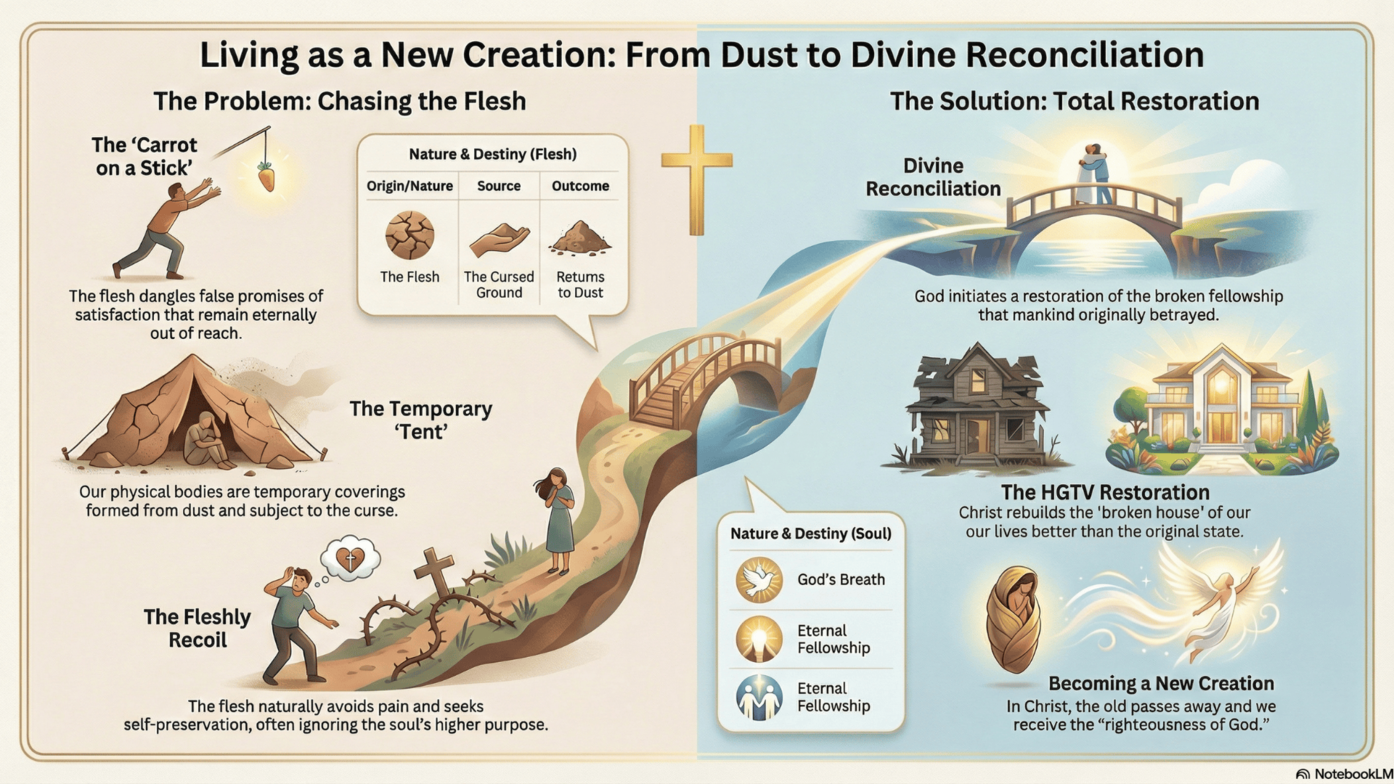
To understand why our search for fulfillment often feels like a treadmill, we have to look at the metaphor of the donkey and the carrot. To keep a beast of burden in motion—perhaps to turn a heavy millstone—the owner dangles a carrot on a stick just inches from the animal's nose. The donkey walks, driven by the sincere belief that diligence will eventually yield the reward.
But the owner knows the truth: the donkey will never catch the carrot. It is a cycle that is as sad as it is cruel. This is the precise mechanism of the "flesh." Because our physical nature is formed from the dust of the ground—a ground that was cursed in the Fall—it is fundamentally incapable of reaching the "carrot" of divine satisfaction. It dangles the promise of fulfillment, but it is a promise it lacks the spiritual currency to pay.
"The enemy dangles before humanity the idea of satisfaction, fulfillment, and happiness. He dangles that in front of our souls, all the while knowing that you can't really have that in the flesh. It’s a carrot on a stick; it can never be reached through human effort alone."
The Dust of Our Origins
Our struggle is written into our very DNA, a reality found in the "origin story" of Genesis 2:7. The Bible describes a two-part creation of humanity: the "dust" and the "breath."
The first part is profoundly humbling. The Lord formed man from the dust of the ground. Pastor Adam Wright notes that this isn't just a theological concept, but a linguistic one—the name "Adam" literally means mud or dirt. We are made of the same material as the earth, and because the ground was cursed following the mutiny in Eden, our flesh is a temporary casing destined to return to the soil.
However, the story doesn’t end in the mud. Life only truly began when God breathed into man’s nostrils. This is the root of the word "inspiration"—the literal "God-breath." While our bodies belong to the dirt, our life comes directly from the eternal Creator. We are a complex union of the cursed ground and the divine breath.
"Then the Lord God formed the man of dust from the ground and breathed into his nostrils the breath of life, and the man became a living creature."
The Tent and the Identity
In his letters, the Apostle Paul refers to the physical body as a "tent." For a modern reader, this distinction is the key to navigating daily stress. A tent is a temporary shelter, not a permanent home. It is a covering, not an identity.
The flesh is programmed for self-preservation. Its natural reaction is to recoil from pain. If you touch a hot welder’s torch, you pull back instantly. In our modern lives, we see this "fleshly recoil" when we face social media criticism, difficult conversations, or professional setbacks. Our instinct is to hide, defend, or retreat to preserve our comfort.
Yet, the soul—when aligned with its Creator—operates on a higher logic. Paul was once stoned and left for dead outside a city; his flesh surely screamed in pain, yet his soul drove him to stand back up and return to his purpose. When we live as new creations, we are no longer governed by the "natural" reactions of our "tent," but by the eternal purposes of God.
The Ultimate Home Renovation
The Bible uses the word "reconciliation" to describe God’s restoration plan. To visualize this, imagine an old, broken-down home. The roof is collapsing, the windows are shattered, and grass is growing through the floorboards. It is a picture of total decay.
Now, imagine the greatest builder in history takes ownership. This isn't a "patch-up" job you’d see on a budget reality show. In this total restoration, the Builder replaces every rusted nail, every warped board, and every splintered beam with materials not of this world. When He is finished, the house is better than it was the day it was first built.
This is the miracle of "justification." As the mnemonic goes: "Just-if-I’d never sinned." Through Christ, God initiates a restoration so complete that He views us as if the decay of our mutiny never happened. He doesn't just fix the "mud" of our nature; He provides a new foundation entirely.
Wearing a New Identity: Dikaiosune
The mechanism of this transformation is found in the Greek word dikaiosune, or "righteousness." Pastor Wright humorously notes it sounds a bit like "Ninja Turtles," but its meaning is profound: it is a new identity that we "wear."
Being a new creation means the "old" version of you—the one tied to the cursed dirt—has passed away. In its place is the righteousness of God. This concept is so radical it often feels "too good to be true," leading many to reject the message entirely. They cannot fathom that God would take our betrayal and replace it with His own perfection.
Yet, we see God’s nature as a Creator of "new things" everywhere. Revelation 21:5 declares, "Behold, I am making all things new." Modern astrophysics even points to an expanding universe—a celestial reminder that God is constantly creating and renewing.
"For our sake he made him to be sin who knew no sin, so that in him we might become the righteousness of God."
Living the Promise, Not the Pursuit
Everything in our material world is in a state of "wearing out." Cars rust, clothes fade, and even the most expensive homes eventually crumble. If you look to the material world for satisfaction, you will remain the donkey chasing the carrot—perpetually in motion, but never arriving.
The promise of the "new creation" is that while the physical "tent" wears out, the inner life is renewed daily. We are invited to stop sprinting toward the mirage of worldly fulfillment and instead rest in the finished work of reconciliation.
Are you currently exhausted from chasing a reward that stays just out of reach, or are you resting in the reality of who God has already made you to be? Stop sprinting toward a mirage; start walking in the reality of a finished renovation.
True fulfillment is found not in the effort of the flesh, but in the daily renewal of the soul through Christ.