Into God's Best for Your Life Part 1

Why "Better" is the Enemy of "Best": Timeless Lessons from an Ancient Relocation
There is a hidden liturgy in our frustrations. Recently, my truck’s failing Bluetooth became a gateway to a forgotten peace. For six months, the connection has been intermittent, cutting out mid-sentence or dissolving into static. Forced back to the "normal radio," I stumbled upon an unexpected relaxation: the relief of relinquishing control. There is a quiet grace in trusting the "dude on the radio" to pick the next song, sparing me the labor of the perfect selection.
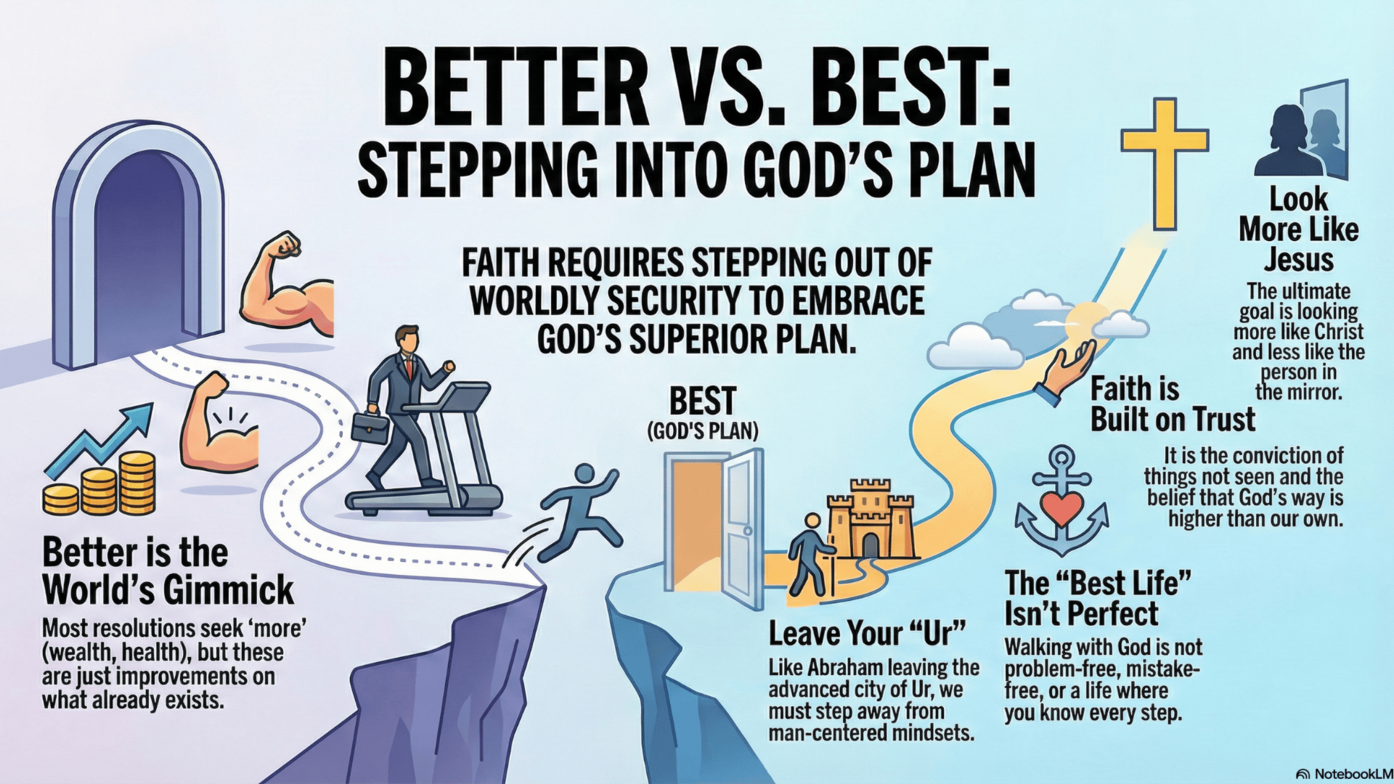
This small surrender stands in stark contrast to the exhausting cycle of the New Year. We are currently inundated with resolutions: exercise more, save more money, eat healthier, and spend more time with family. In our cultural shorthand, these are often summarized as "improving physical and mental health." But notice the linguistic thread: more. We are obsessed with "improvements on what already is." We are trapped in the comparative life, seeking a slightly shinier version of our current reality rather than seeking something fundamentally different.
The Gimmick of the Comparative Life
Modern goals are almost always rooted in the pursuit of "better"—fitter, wealthier, more productive. While the desire for improvement isn't inherently sinful, it often functions as a spiritual distraction. Since the Great Flood, a gimmick has been at play: the enemy offers us endless iterations of "better" to keep us from ever reaching for "best."
When we serve a God who is the absolute standard of "best," settling for "better" is a tragic compromise. As we grow in our relationship with Jesus, we find the "more" we’ve been chasing is already settled. You will never find a relationship or a purpose that is more than Him, because He is the best.
From the Sophistication of Babel to the Shadows of Ur
To understand the call of Abram (later Abraham), we must understand the geography of rebellion. Abram lived in Ur of the Chaldeans, an advanced, wealthy city located roughly 250 miles downriver from the Tower of Babel. Ur was the commercialized, sophisticated successor to Babel’s mindset.
The "Babel mindset" is simple: "God, watch what we can do; let us make a name for ourselves." It is the spirit of self-sufficiency. When God scattered the people at Babel, that mindset traveled 250 miles south to Ur. It became a hub of darkness. Ur was the capital of the worship of the moon god, "Nana"—a name that ironically matches what my children call my mother (though I suspect my southern accent may be doing the ancient Akkadian name a disservice). Interestingly, the Akkadian name for this deity sounds strikingly similar to the word "sin."
Scripture reveals in the book of Joshua that Abram’s father, Terrah, was an idolator. God did not appear to Abram because he was a "sold-out believer"; He appeared to a pagan in a land of sophisticated idolatry. God called him out of the "way of man" to re-engineer his mind for the "way of the Best."
The "Best" Life is Not a Problem-Free Life
There is a persistent myth that stepping into God’s "best" results in a life of sanitized comfort. The life of Abram shatters this illusion. Walking in faith is not an escape from reality; it is an engagement with it through a different lens.
God’s "best life" is explicitly not:
- Problem-Free: Abram dealt with constant conflict, much of it centered on his nephew Lot, who was a perpetual source of trouble and required constant rescue.
- Mistake-Free: Abram lied about his wife in Egypt and famously tried to "fix" God’s promises through Hagar and Ishmael. Faith does not grant us immediate perfection; it grants us a New Direction.
- A Life of Full Knowledge: Abram was told to go to a land God "would show him." He had to leave his security without a roadmap.
Crucially, God’s best involves the discipline of waiting. If you want to walk in the "best life," you must prepare to wait on the Lord—a command that echoes throughout the Psalms. Humanity hates the wait, but God uses the silence to dismantle our self-reliance.
The Three Pillars of the Best Life
The writer of Hebrews provides the necessary lens for Genesis 12. While Abram could see the physical security of Ur, he acted on the "conviction of things not seen." He left a city of advanced aqueducts and wealth to live in temporary tents. Why? Because he was looking for a city with foundations whose designer and builder is God (Hebrews 11:10).
Walking in God’s best is built upon three pillars:
- Trust in God’s Character: The foundational belief that God wants what is best for you. This trust is the only source of the "peace that passes understanding."
- A Change in Direction: True faith is never just intellectual; it inevitably changes where you go and what you do. It requires an exodus from your personal "Ur."
- Priority of Will: It is a life that cares more about God’s way than personal preference or self-constructed security.
The "Nevertheless" Shift: Looking Like the Image
God did not call Abram because He needed a human assistant. God is self-sufficient and "best" in Himself. Instead, He was creating a model for humanity. The core purpose of the "call to leave" is not a status shift, but an image shift.
Everything in the life of faith is designed to make you look more like Jesus and less like the person in the mirror. This is the re-engineering of the mind. We see the pinnacle of this in the Garden of Gethsemane. When Jesus faced the cross, He prayed for another way, yet He concluded with the ultimate posture of the "best" life: "Nevertheless, not my will, but yours." This total submission of the will—the "nevertheless"—is the definition of walking in God's best.
Conclusion: Leaving Your Own "Ur"
We all live in some level of "Ur." We have our versions of security, our comfort zones, and our "401k mindsets" where we feel in control of our futures. Ur was a great city, perhaps even a "better" city than most in the ancient world, but it wasn't the best because God wasn't the foundation.
The question that remains for us is the same one Abram faced: Do you really believe that God has something that "Ur" doesn't?
Stepping into God's best is not a guarantee of worldly comfort or a higher social status. It is a guarantee of transformation. God's best isn't about your comfort; it's about your journey toward looking more like Him. It's time to stop settling for a better version of "Ur" and start walking toward the city that has foundations.